How I build Conatus with AI
Conatus is a self-hosted task manager I started in July. When I posted it on r/selfhosted, it got downvoted to hell. Okay, I get it. The subreddit already gets a steady stream of sloppy AI-built projects, so anything made with AI gets dismissed instantly. It doesn't help that it's a task manager, since there are already plenty of those. So it's fair to ask why it exists and whether you can trust it on your own server.
Why Conatus exists
I like Todoist a lot. It's still my favourite task manager. But I want to own my data and rely as little as possible on closed-source services. When a company holds the only copy of my task list, it decides who can read it and whether I can keep using it. If it changes its terms or closes my account, my tasks just disappear. GDPR gives me the right to a copy, but only of whatever they still have. They can take a month to send it. On my own server, the data is mine and I am the one responsible for keeping it safe.
The obvious question is why I didn't just use Vikunja, the best-known self-hosted task manager. It's a mature, solid project with more than 5,000 stars on GitHub. But I find it harder to use than Todoist and I don't like how it looks. I wanted Todoist itself on my own server: the familiar interface, the quick add syntax, P1 to P4 priorities, due dates and deadlines.
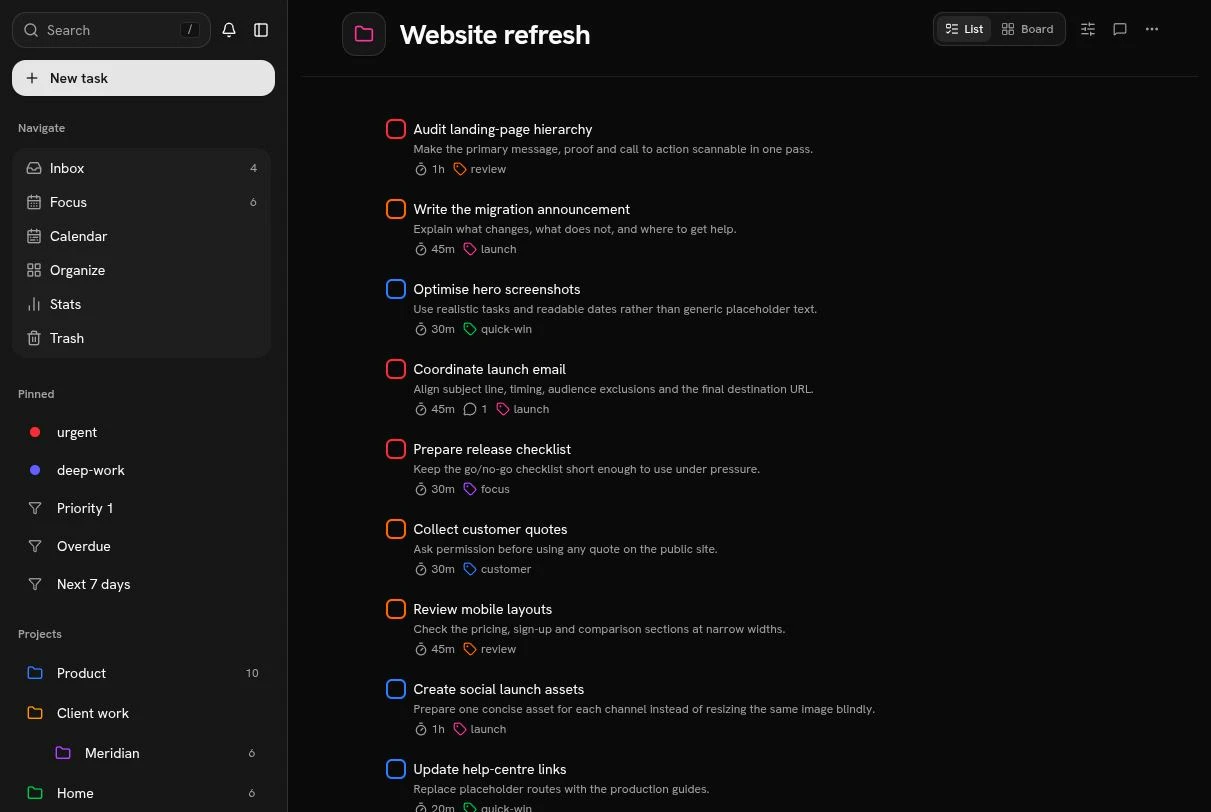 A project in the demo.
 Quick add turns plain text into a due date, a priority and a label.
The comparison on the Conatus website lists what Vikunja has that Conatus doesn't.
Conatus is for people who are leaving Todoist and want the same workflow. It's also for people who want AI agents working through their task list.
How and why I build it with AI
In June, I was blown away by Opus 4.8. It was really good at writing code and its agentic capabilities already seemed insane. I wanted to test how good these models really are, so I started a project where AI would write most of the code. That's how Conatus was born. Most of my work is deciding what Conatus should do and what ships.
These days I mostly use Opus 5.5 and Claude Code has improved a lot too. I used to use the CLI, but I switched to the desktop app because its interface is nicer and easier to use. I haven't needed to open a text editor for Conatus since. Hermes, the agent that runs on my home server, tells me about new issues and pull requests from other people, so I know when there's work to do. My agents write pull requests, find and fix bugs and help me decide what to work on next. I also use Conatus to develop Conatus, so the agents can keep track of their progress.
Relying this much on Claude Code is a separate problem. Any kind of vendor lock-in is not ideal, so I'm trying OpenCode with OpenAI's models and with models I host myself, which I'll write about in a later post.
Being wary of software built with AI is reasonable. Code nobody understands can break in ways nobody notices and with Conatus it has. With self-hosted software, the person who notices is a stranger whose data is on the line, so I have to rely on checks that don't care who wrote the code.
Every pull request has to pass type checking, linting, unit tests and a production build. Then end-to-end tests run the app in a real browser against a freshly migrated database, through quick add, recurring tasks, sharing, drag and drop, keyboard shortcuts and API tokens. Pull requests that touch the database or the Compose setup also run the upgrade check. It installs each published release, fills it with some data and upgrades it to the new version.
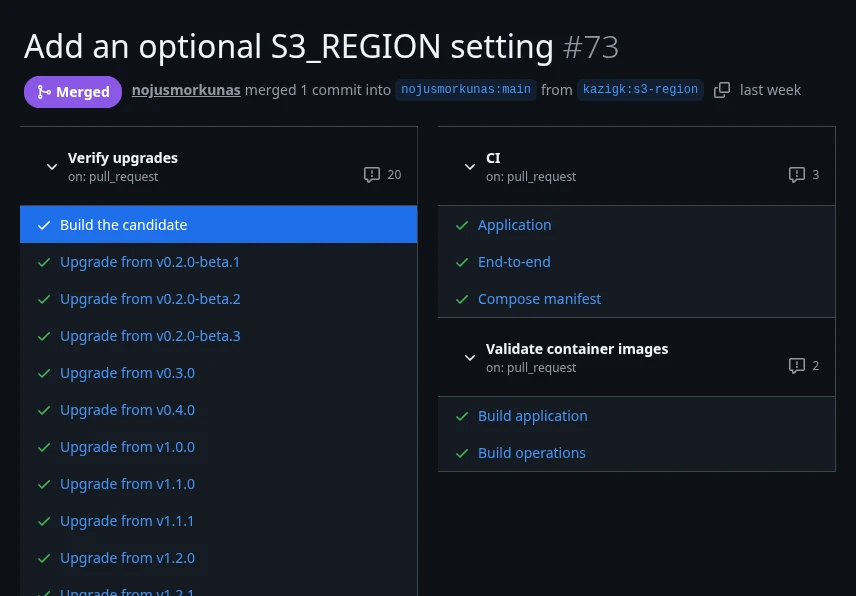 The 25 checks on a pull request from another contributor.
You can see every check and its logs on that pull request.
Some checks exist because the bug they catch would be silent. To block injected scripts, Conatus gives every page load a random code and only lets the browser run scripts tagged with it. Next.js can render some pages once at build time, before that code exists. In production, those pages load fine but never respond to a click, while in development everything works. The build now fails if any page gets rendered ahead of time.
None of this actually proves that the code is good. All it means is that a mistake has to get past a lot of checks before it reaches anyone's server, regardless of who (or what) made it.
Four months in
The other fair worry is that AI-built projects get abandoned once the fun part is done. I can't prove what happens next, but I plan to maintain it for as long as I use it myself.
The first four months:
- 19 July: first commit
- 21 July: first release
- 21 August: first release of the MCP server, so AI agents can work with your tasks
- 18 September: v1.0.0 and a mention in the selfh.st weekly newsletter
- 1 October: first pull request from someone else
- 5 November: Android app 1.0.0
- 17 November: v1.5.2, the 21st release
All 14 issues so far came from 10 other people and two people besides me have had pull requests merged.
If you need teams or CalDAV today, use Vikunja. If you're leaving Todoist or want AI agents on your task list, try the demo with demo as both username and password, read the documentation or find the code on GitHub.